
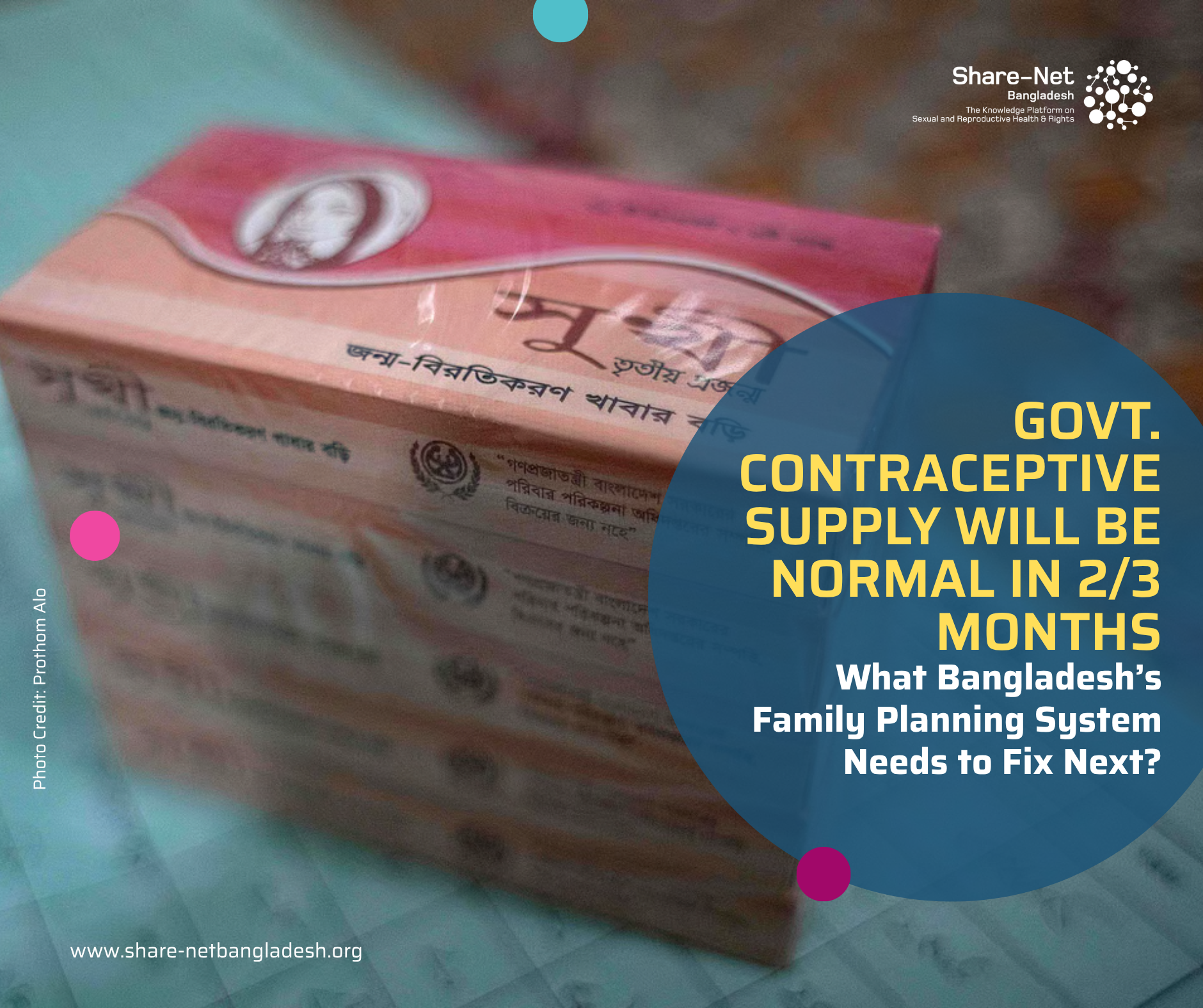
Govt. Contraceptive Supply will be Normal in 2/3 Months: What Bangladesh’s Family Planning System Needs to Fix Next?
Health and Family Welfare Minister Sardar Md Sakhawat Husain told Parliament on 7 September that contraceptive and essential medicine supplies had fallen short of demand over the past three years, causing temporary disruption to the family planning programme. He said procurement is now at an advanced stage and supplies should return to normal within the next two to three months.
The announcement comes at a critical time for Bangladesh’s sexual and reproductive health and rights (SRHR) agenda. The country’s latest Bangladesh Multiple Indicator Cluster Survey, conducted by the Bangladesh Bureau of Statistics with UNICEF, shows that 58% of currently married women aged 15 to 49 reported using some form of family planning, while 18% had an unmet need for family planning. Demand for family planning satisfied with modern methods stood at 74%.
The numbers also expose important inequalities. MICS 2025 found that demand for family planning satisfied with modern methods was 80% among the poorest group, compared with 70% among the richest. Among married girls aged 15 to 19, modern contraceptive use was 45%, while unmet need stood at 18%.
These figures suggest that restoring supplies is necessary, but not sufficient.
For someone trying to plan when to have a child, a contraceptive shortage is not simply a supply-chain problem. It can mean a missed choice, an unintended pregnancy or a break in continuity of care. That is why the government’s latest promise to restore contraceptive and essential medicine supplies within two to three months matters far beyond procurement figures.
Bangladesh’s Family Planning 2030 commitments already recognise the need to improve access to modern contraceptives, particularly for adolescents, postpartum women, post-abortion care users and disadvantaged populations. The commitments also call for stronger information, counselling and community-level services.
The country’s progress should not be overlooked. FP2030 estimates that around 22.16 million women were using modern contraceptive methods in 2024, helping prevent an estimated 7.97 million unintended pregnancies and 8,500 maternal deaths.
But continuity remains a concern. UNFPA Bangladesh reports that about 30% of contraceptive users discontinue a method within 12 months, while quality of family planning services requires further attention.
The minister also pointed to another structural challenge: human resources. Of 1,549 approved entry-level Medical Officer positions in the Directorate General of Family Planning, 807 were vacant, according to his parliamentary response. Recruitment proposals and efforts to fill other vacant posts are underway.
That makes the government’s two-to-three-month target an important first test, rather than the final solution.
“Normalising supply” should ultimately mean more than having contraceptives back on shelves. It should mean that a young person, a couple in a rural community or a woman seeking postpartum care can obtain the method they need, receive accurate counselling and continue using it without unnecessary interruption.
The real measure of recovery will therefore be simple: can Bangladesh turn restored supplies into reliable, rights-based and people-centred family planning services?
Source: TBS NEWS